

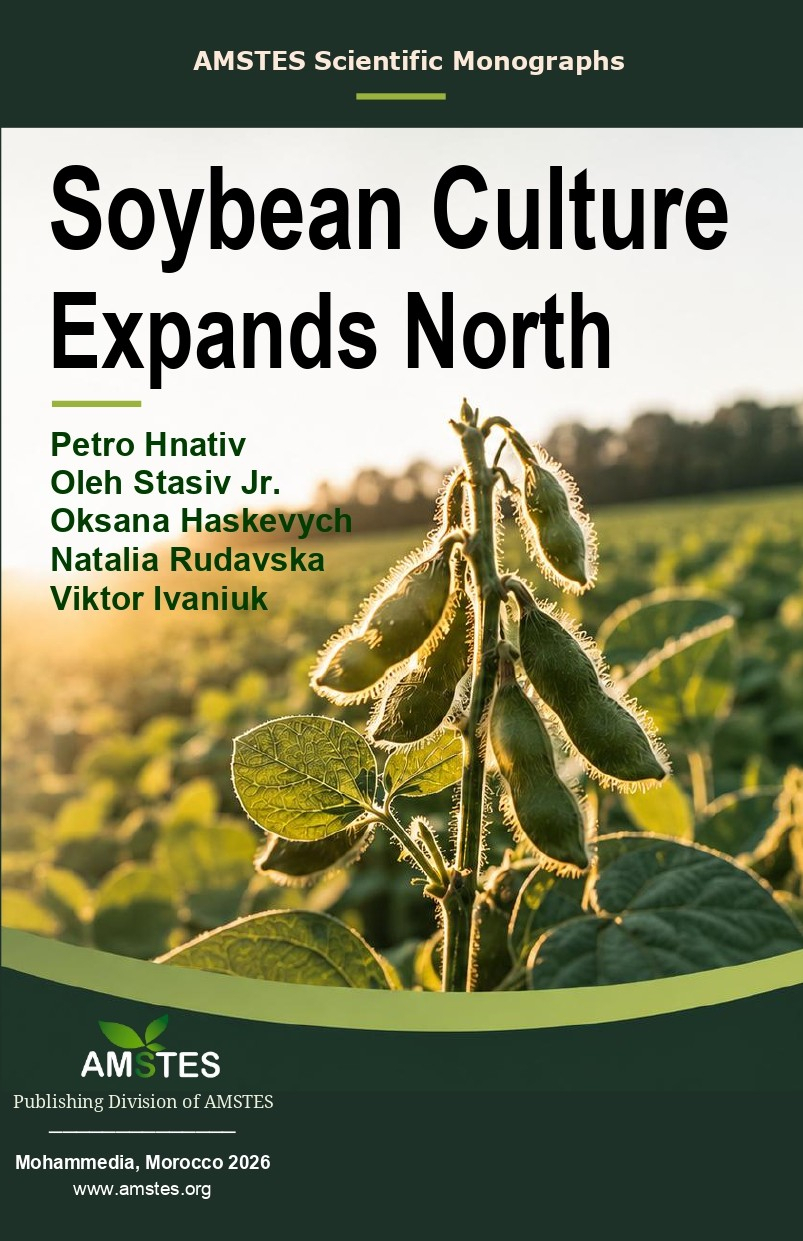


Soybean Culture Expands North
Soybean Culture Expands North examines the scientific foundations of soybean cultivation under the emerging conditions of the Western Forest-Steppe region of Ukraine. The book presents a comprehensive analysis of global experience in the effective use of fertilizers in crop production and provides practical recommendations on mineral fertilization systems, the application of nitrification inhibitors, and the use of soybean seed inoculants. Particular attention is given to strategies aimed at achieving high grain yields in combination with environmentally safe soil management.
Drawing on agronomic research and practical field experience, the monograph offers valuable guidance for the sustainable development of soybean cultivation in new agro-climatic zones.
This book will be of interest to researchers, farmers, academics, and students in the fields of agronomy, crop science, and sustainable agriculture.
How to Cite
Table of Contents
- Front Matter
-
Chapter 1: Expansion of Soybean Cultivation and Optimal Fertilization in New Growing Regions
- 1.1 The Role of Nitrogen in Soybean Nutrition
- 1.2 Forms of Nitrogen Compounds and Nutritional Pathways in Soybean
- 1.3 Synthetic Inhibitors of Nitrogen Transformation in Soil
- 1.4 Activation of Soybean Nitrogen and Phosphorus Nutrition Using Inoculants
- 1.5 Climate Change on Earth: Probable Benefits and Risks for Agricultural Technologies
-
Chapter 2: Methods and Conditions of Research
- 2.1 General Research Concept
- 2.2 Assessment of Soil Nutrient Regime and Nitrogen Forms
- 2.3 Soil Profiles of the Experimental Fields
- 2.4 Methods for Analysis of Grain Biochemical Composition and Economic Efficiency of Soybean Technologies
- 2.5 Analysis of Climatic Trends
-
Chapter 3: Soil Agrochemical Indicators and Mineral Fertilization System for Soybean
- 3.1 Effect of Mineral Fertilization of Soybean on the Content of Available Phosphorus and Exchangeable Potassium
- 3.2 Effect of Fertilization Systems and Inoculation on the Availability of Nutrients to Plants
- 3.3 Changes in Nitrate Content Depending on the Rates and Forms of Nitrogen Fertilizers, the Effect of the Inhibitor, and Seed Inoculation
- 3.4 Correlations of Soil Nitrogen Parameters, Fertiliser Rates and Nitrapyrin Application
-
Chapter 4: Phenology of Soybean Yield Formation Under the Influence of Weather and Technology
- 4.1 Climate Change Trends in Western Ukraine
- 4.2 Temperature Regime and Precipitation in 2022–2024
- 4.3 Phenology of Soybean Vegetation
- 4.4 Soybean Growth Biometry Under the Influence of Innovative Practices
- 4.5 Vegetation Dynamics of Symbiotic Nodule Formation
- 4.6 Pod and Grain Formation
- 4.7 Formation of the Assimilatory Apparatus and Overall Assessment of Soybean
- 4.8 Photosynthetic Potential of Soybean Cultivars Under New Cultivation Conditions
-
Chapter 5: Natural Factors and Innovative Approaches to Soybean Yield Formation in Western Ukraine
- 5.1 Influence of Fertilization Systems, Nitrapyrin, and Inoculants on Grain Yield
- 5.2 Interaction of Innovative Practices and Natural Factors on Soybean Productivity
- 5.3 Effect of Microbial Preparations and Foliar Feeding
-
Chapter 6: Biochemical Indicators of Soybean Grain Quality at the Northern Limit of Its Distribution in Ukraine
- 6.1 Protein Content in Grain
- 6.2 Content of Fat, Fiber, and Other Substances
- 6.3 Analysis and Modeling of Relationships Between Grain Quality Indicators
- 6.4 Synergy of Microbial Preparations and Foliar Top Dressing in the Influence on Protein Accumulation in Soybean Varieties
-
Chapter 7: Economics of Soybean Production in the Western Forest-Steppe
- 7.1 Economic Factors of Soybean Cultivation in Western Ukraine
- 7.2 Economic Indicators of the Efficiency of Fertilizers, Nitrapyrin, and Inoculants
- 7.3 Economic Efficiency of Soybean Cultivation Under the Use of Microbial Preparations and Foliar Feeding
- Index